
This section discusses specific preferences of the INFUSE style regarding different punctuation, especially in cases where the standard is ambiguous or allows for multiple possibilities.
Commas
Coordinated sentences with “not only… but also”
Although general rules discourage using commas in this structure, employing them can promote a smoother reading flow if it coordinates two distinct verb phrases/predicates or, more simply, long clauses:
“In short, successful channel marketing not only mitigates risk, but also enables all involved to secure more value”
Oxford comma
The Oxford comma, also known as the serial comma, is the comma preceding the word “and” in a sentence listing three or more elements:
“Iterative demand generation campaigns […] can be continually leveraged to refine your qualification criteria, targeting, channels, content, and touchpoints”
Despite being considered optional by most language manuals and style guides, the Oxford comma is invaluable in dispelling ambiguity in certain scenarios. For standardization, please employ this comma in all cases.
This same principle applies to sentences that follow a similar logic but utilize “or” instead of “and,” which should also receive the serial comma:
“Depending on the nature of the purchase (and company size), the buyer’s journey might also cross over into legal, finance, or operations departments.”
Finally, this comma should also be utilized before “etc.” in sentences in which it is the last out of three or more listed elements. In this case, the “and” must be skipped, as it is implied by the Latin word “et” that integrates this expression:
“Determine where AI can be implemented to streamline analysis and create assets for A/B testing, personalization, etc.”
Periods
Most of the period usage for the INFUSE style follows standard practices. Some exceptions apply in which it must eventually be omitted:
CTAs
Most of our CTAs consist of one short, action-oriented sentence and do not use a period:
“Read our Outlook 2025 AI chapter for more insights →”
However, the final CTA in our articles is usually longer, consisting of three distinct sentences.
While the first and last of these follow the same formula and therefore skip the period, the second tends to be longer and go into deeper detail about our offerings, thus necessitating a period. See the final CTA for that same article:
LAUNCH DEMAND-READY CONTENT THAT GENERATES
QUALIFIED ENGAGEMENT
INFUSE demand experts develop custom-tailored content that matches the unique needs of your key buyers, and activates demand through a proprietary first-party 252+ million B2B profile database.
Contact the team to craft your content strategy and drive qualified engagement →
Blocks, table cells, and bullet points
There are two admitted variations for period usage in block groups, tables, and bullet lists:
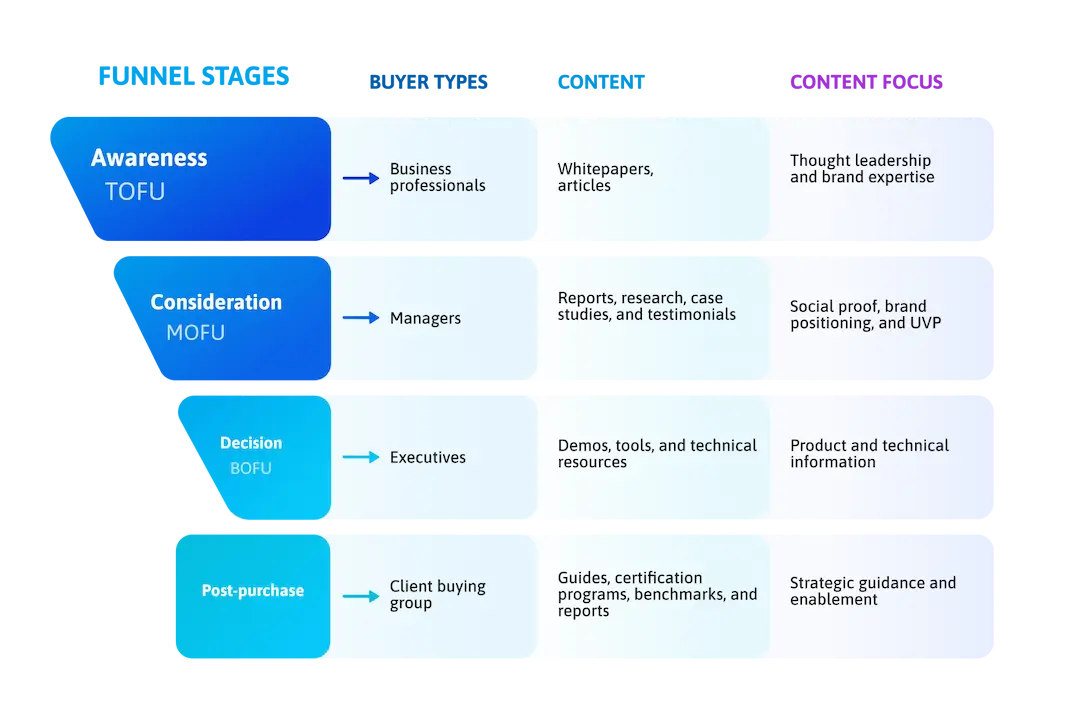
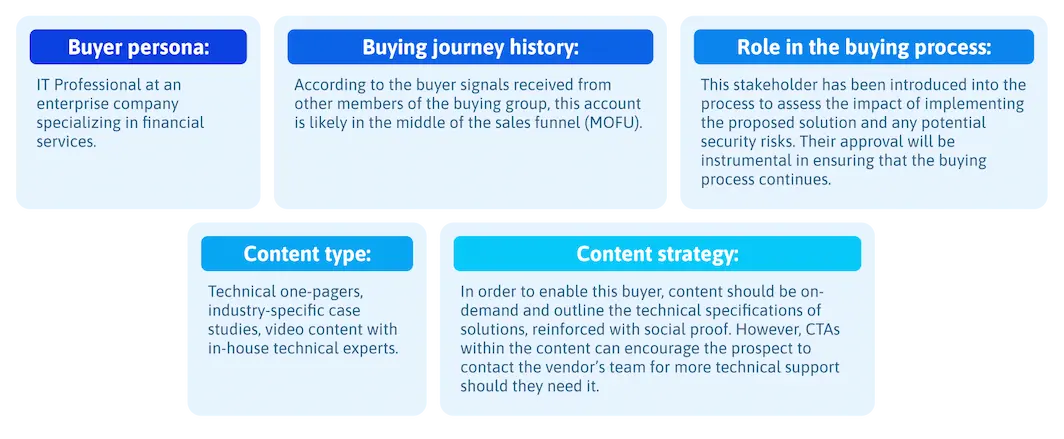
- If all items in a group, table, or list consist of single sentences, periods must not be used
- When at least one element contains two or more sentences separated by a period, the punctuation must be used at the end of all items
For an example, see the two graphics below, both belonging to the same article:
Apostrophes
Usage of the apostrophe to mark the genitive case (e.g., “today’s competitive marketplace”) is carried out as usual, but the punctuation should not be used to construct plurals for acronyms and numbers:
Calls-to-action (CTA’s)
Calls-to-action (CTAs)
AIDA qualification has been
associated with the sales funnel
model since the 1920’s.
AIDA qualification has been
associated with the sales funnel
model since the 1920s.
Individual letters, such as in grading, are an exception: “She received six A’s.” Constructed verbs with two-letter abbreviations also admit the apostrophe: “I CC’d her in the email.”
Quote marks
INFUSE assets utilize these marks mostly to indicate direct quotes from our leadership, testimonials in case studies, and sources in press releases. However, two aspects must be considered when utilizing quote marks:
American English quotation mark standards
The American and British English standards recommend different layouts for utilizing quotation marks in combination with other punctuation.
American English specifies the following rules for their layout:
- When quotes are featured within a sentence, followed by a comma or a period, these should be inserted within the quote marks, even if the punctuation is not in the original:
“The true power of brand-to-demand lies in its adaptability,” said Alex. - Quotes ending in punctuation marks other than commas and periods must include the original punctuation within the quotes, while the other sign is moved outside:
“What results can INFUSE offer?”, asked the prospect.
The British variation is discussed in a later chapter.
Typographer’s quotes
Writers often use multiple platforms and text processing software in their craft. However, applications might interpret commands and characters differently. For example, sophisticated platforms such as Microsoft Word and Google Docs automatically implement typographer’s quotes, while other websites and plain text editors such as Notepad maintain simple quotes.
A single variation must be standardized across our publications, and the INFUSE style adopts typographer’s quotes and apostrophes:
SIMPLE QUOTES
TYPOGRAPHER’S QUOTES
Quote mark
Quote mark
Opening quotes
Closing quotes
Apostrophe
Search your draft for quote marks and apostrophes after conclusion to ensure all of them are displayed in the latter variation. For this, retyping the character on Google Docs will suffice.
Single quote marks
Single quote marks (‘ ’) are seldom used in INFUSE materials. The only recurrent usage for these signs is to substitute double quotation marks when a given quote itself contains another quote:
“‘We’re excited to partner with INFUSE […],’ said Elliot Smith, 6sense Head of Partnerships.”
— from INFUSE Unveils Strategic Partnership with 6sense to Transform
Demand Intelligence and Activation
Please note, however, that British English switches double and single quotation marks, as discussed in the respective chapter.
Dashes
Em dash
When employing dashes in your writing, the INFUSE standard utilizes the em dash (—, Alt+0151) without spaces on either side.
“60% of leaders worry that their organization lacks a congruent plan and vision for implementing AI—with a further 59% expressing concerns about quantifying the impact of AI on productivity.”
En dash
INFUSE style admits only one usage for the en dash (–, Alt+0150): offsetting the date and location of publishing at the beginning of a press release:
“Boca Raton, FL, October 29, 2024 – INFUSE, the top global B2B demand performance provider, today announced a new partnership with HG Insights”
Ellipsis
INFUSE assets utilize ellipses when suppressing sections from direct quotes, always within square brackets: […]. Additionally, the standard is to use the ellipsis character (…, Alt+0133), instead of three regular periods.